The Canary Islands as an Atlantic Crossroads: Eyda M. Merediz at LACUA
On Wednesday 9 September, LACUA welcomed Eyda M. Merediz, Associate Professor at the University of Maryland, for the first event of the centre's autumn programme.
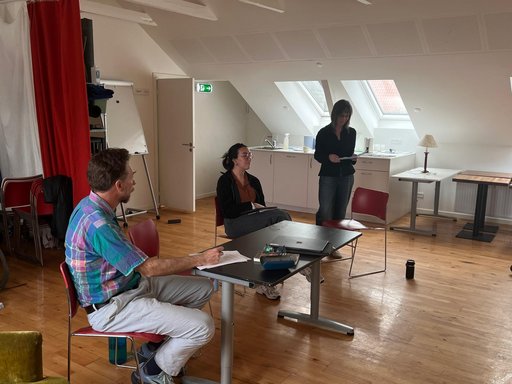
On Wednesday 9 September, LACUA welcomed Eyda M. Merediz, Associate Professor at the University of Maryland, for the talk The Canary Islands in the Early Modern Period: Atlantic Crossroads. It was the first event of the centre's autumn programme.
Merediz surveyed key texts in the cultural and literary history of the Canary Islands from the 15th to the 17th centuries, and invited participants to rethink the archipelago's place in Atlantic history. The islands are often described as a testing ground for European colonialism before its expansion into the Americas. They were also a place where ideas and identities returned from the New World and were renegotiated in writing. Seen from the Canaries, the Atlantic looks less like a one-way route and more like a web of relationships linking Europe, Latin America, the Caribbean and Africa.
The talk draws on Merediz's long-standing research on the subject. Her book Refracted Images: The Canary Islands through a New World Lens. Transatlantic Readings (Arizona Center for Medieval and Renaissance Studies, 2004) argues that early modern portrayals of the islands were shaped by classical models and also by Spain's experience in the Americas. The book reads works by Alonso de Espinosa, Antonio de Viana and Lope de Vega together, and places them within transatlantic debates on conquest, evangelisation and colonisation.
For LACUA, the talk showed that Latin American studies doesn't stop at the continent's borders. It also reflects the centre's commitment to dialogue across regions and disciplines, with research from and about Latin America circulating in both directions.
We warmly thank Eyda M. Merediz for her visit, and everyone who joined us for an inspiring afternoon.
LACUA Autumn 2026
August 2026
Programme update
LACUA Fall 2026 — Upcoming Events and New Member
Teatro Trono, Evelio Rosero, a new intercultural business workshop series, and a new Postdoc — LACUA's autumn programme is packed.
LACUA is entering autumn 2026 with a rich and varied programme. Below is an overview of upcoming events and news from the centre.
Workshop with Teatro Trono — 18 September, 2:00–3:30 pm
Sign up for this workshop on 18 September from 2:00 to 3:30 pm with Teatro Trono, a theatre troupe from Bolivia currently on tour in Denmark. All students and faculty from the Department of Communication and Culture are welcome.
"The future begins today" has been Teatro Trono's motto since its founding in 1989. For young people in Bolivia's marginalised areas, few doors are open — but instead of waiting for changes that may or may not come, the young people of Teatro Trono are taking responsibility for their own future.
In this workshop, three theatre educators — Claudio, Nahir, and Daniel — will introduce participants to the organisation's educational and artistic methods known as Descolonización del cuerpo ("decolonization of the body"). Through practical exercises and discussions, participants will explore the context in which the artists work in El Alto, Bolivia; the importance of cultural work for children and young people in underprivileged circumstances; and examples of personal and collective strength through art and theatre.
Find out more about Teatro Trono's tour in Denmark at www.globalkids.dk and learn more about the organisation at spormedia.dk.
Literary conversation with Evelio Rosero — 22 September, 4:30–6:30 pm
This September, Aarhus welcomes Evelio Rosero, one of Colombia's most acclaimed living writers. His work — characterised by prose that is both serene and deeply moving — explores how violence and war permeate everyday life and test the limits of the human condition. Recipient of the Tusquets Novel Prize and the Independent Foreign Fiction Prize, Rosero is one of the most distinctive voices in contemporary Latin American literature. Part of his work has been published in Danish by Aurora Boreal.
Join us for this literary conversation in Spanish, organised together with LACUA, and get to know the author and his work up close.
📅 Tuesday, 22 September | 🕓 4:30–6:30 pm | 📍 DOKK1, Aarhus (Teaching Room 1) | 🎟️ Free admission
Workshop series: Interculturality and the Business Context — Fall 2026
Building on the two-workshop series on humanitarian aid in conflict zones (March and April 2026), LACUA proposes a more in-depth follow-up workshop for autumn 2026. The series will focus on the intersection of business, intercultural dialogue, and themes central to LACUA's agenda, offering students a space to engage with real case scenarios from Danish organisations. A certificate of completion will be awarded to participants. Three sessions, bringing together practitioners and researchers affiliated with LACUA.
Welcome: Pablo Aguilera Del Castillo
LACUA is pleased to welcome Pablo Aguilera Del Castillo as a new member. Pablo joins as a Postdoctoral Researcher at the Department of Anthropology, School of Culture and Society, Aarhus University.
4 June 2026
Book launch
New Book Examines How America's Growth Obsession Is Poisoning Its Own Water Supply
A public discussion in Aarhus brought together researchers from México, Brazil, Denmark, and the US around Daniel Mains's new book on water, politics, and infrastructure in urban Oklahoma.
Nourishing Growth and Suffocating Life: Water, Politics, and Infrastructure in Urban Oklahoma was the centerpiece of a book launch and public discussion held on 4 June at Café Mellemfolk, Mejlgade 53, Aarhus C. The event was co-sponsored by CEBRAGA, the Departments of Global Studies and Anthropology, and the AU Water Cluster — with LACUA also participating.
Author Daniel Mains, Professor at the University of Oklahoma, argued that subsidised economic growth carries self-destructive consequences for drinking water and stormwater infrastructure.
Ciara Kierens, Professor at Aarhus University and leader of the FILTERSCAPE project, brought perspectives on water politics in Denmark and Mexico. Léa Lebeaupin-Salamon contributed from her research on water politics in Brazil. The event was moderated by Derek Pardue, co-founder of CEBRAGA.
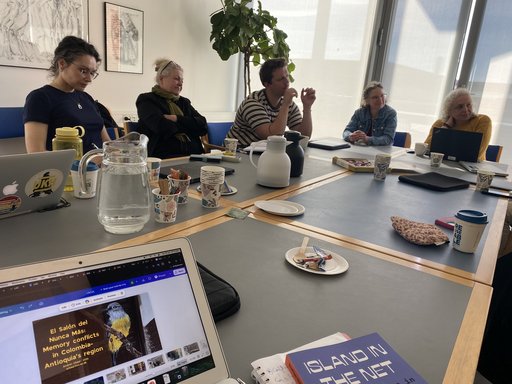
LACUA opened its 2026 programme with its first gathering of the year, featuring presentations by Steffen Köhn on digital culture in Cuba and Andrés Chaur on memory and post-conflict communities in Colombia.
The Latin American Centre at Aarhus University opened its 2026 programme with its first gathering of the year, bringing together colleagues from across disciplines: culture and communication, anthropology, linguistics, memory studies, and intercultural studies.
Digital networks and grassroots culture in Cuba
Steffen Köhn, Associate Professor of Anthropology at Aarhus University, shared ethnographic work from his forthcoming book Island in the Net: Digital Culture in Post-Castro Cuba, exploring how Cuban society has navigated digital technology — foregrounding agency, creativity, and everyday resistance through grassroots networks.
Memory, care, and post-conflict communities in Colombia
Andrés Chaur, Visiting PhD Scholar at Aarhus University and co-coordinator at LACUA, presented his doctoral research on the Salón del Nunca Más in Granada, Antioquia — a memory site built by survivors and victims' families as an act of collective witness and civic repair. The research advances the concept of cuidado de la diferencia.
LACUA as a platform for dialogue
The meeting reaffirmed LACUA's purpose as a sustained, multidisciplinary hub where Latin American cases speak productively to questions that matter in the Danish and Scandinavian context. Researchers interested in engaging with LACUA's programme are warmly encouraged to reach out.